How high-volume restaurant operators can balance payment security and speed at scale

Executive Summary
For high-volume restaurant operators, the checkout moment is where guest satisfaction, fraud exposure, and revenue all converge — in seconds. Most operators assume that stronger security means slower service. That assumption is an artifact of fragmented infrastructure, not an inevitable tradeoff. With the right architecture, speed and security reinforce each other. Here's how to build a payment system that delivers both.
Restaurants can balance security and speed at checkout by replacing fragmented point solutions with a unified payment infrastructure. This includes contactless terminals, tokenization, and end-to-end encryption to protect cardholder data without adding friction. The right architecture reinforces both security and speed, instead of putting them in competition with each other — especially in high-volume QSR environments where transaction velocity and peak-hour spikes significantly amplify both operational pressure and fraud exposure.
The checkout moment is a critical business decision
There’s one crucial moment in time when guest satisfaction, fraud exposure, table turnover, and profit margins converge in seconds. That’s the moment of checkout, and it’s essential to business success for restaurants, particularly in QSR and fast casual settings where seconds per transaction directly impact queue length, order abandonment, and overall daily ticket volume.
The problem is that many restaurant operators assume they can’t achieve all of these goals at once — protecting payments, satisfying customers, and enabling fast checkout. They believe that adding security layers, while necessary to avoid fraud, inevitably slows service.
That belief, however, is tied to an outdated architecture. The right tools and strategies, architected correctly, can improve these processes and streamline restaurant experiences.
This guide provides a practical framework for building a unified restaurant payment system that allows for both speed and security at checkout.
Checkout speed is a revenue metric, not just a convenience metric
A rapid payment process isn’t just convenient for customers; it directly impacts revenue. Faster checkouts increase transaction throughput per hour, reduce queue abandonment, and enable more orders to be processed during peak demand. This drives higher daily revenue without adding seats, kitchen capacity, or labor hours.
That’s why the moment of checkout is critical for growth.
The cost of a slow checkout
Slow checkouts, on the other hand, can have a damaging impact on restaurants. Payment delays leave tables sitting idle between covers, which can result in direct revenue loss. The impact on employees is also significant; slow systems can increase server workload and contribute to front-of-house frustration in an industry that already has a high turnover rate.
3 underestimated threats restaurant operators are actually at risk for
While restaurants have to provide speedy checkout processes, they also must ensure payments are properly secured, authenticated, and protected. According to IBM, the average cost of a breach for hospitality businesses is $3.6 million. Businesses may overlook these risks and forego certain payment protections to prioritize speed at checkout, but underestimating these risks can lead to costly legal issues and damaged reputations.
Specifically, restaurant operators are vulnerable to three primary payment threats:
POS system attacks
POS environments are a primary attack surface for malware, ransomware, and card skimming, particularly in distributed QSR estates running multiple POS versions, payment terminals, and middleware layers across brands, regions, or franchise groups.
For IT and store systems teams, the risk is not just the attack itself, but the operational fragmentation that follows a breach: different vendors, inconsistent security patching cycles, and misaligned SLAs across POS, payment processors, and device providers can slow detection, complicate remediation, and extend downtime across stores. In high-volume QSR environments, even short disruptions can translate directly into lost throughput and revenue leakage.
Account takeover fraud (ATO)
Account takeover fraud occurs when attackers gain access to customer credentials, often through phishing or credential stuffing, and use stored payment methods to make unauthorized purchases.
In modern QSR ecosystems, the risk is amplified by cross-channel ordering environments spanning mobile apps, kiosks, drive-through POS systems, and delivery integrations. When identity and payment credentials are reused across these touchpoints, attackers can exploit weak links in authentication flows to initiate fraudulent transactions that appear legitimate at checkout.
This also creates downstream complexity for store systems teams, including reconciling payment events across multiple systems and processors, and potential settlement discrepancies when transactions are routed through different payment paths.
Friendly fraud and chargebacks
Friendly fraud occurs when a guest disputes a legitimate transaction, intentionally or unintentionally, to obtain a refund. In QSR environments, this risk is increasingly tied to omnichannel guest journeys that span app ordering, drive-through pickup, kiosk ordering, and loyalty redemption.
For example, a single order may be placed via mobile app, modified or fulfilled at the drive-through POS, and partially paid or discounted through a loyalty redemption. When a dispute arises, fragmented payment and commerce systems make it difficult to reconstruct the full transaction path across these touchpoints. This increases chargeback exposure, slows dispute resolution, and places additional operational burden on finance and IT teams tasked with reconciling inconsistent data across systems. According to Mastercard, incidences of chargebacks are rising rapidly and merchants say 45% of their chargebacks are fraudulent.
Why card-present environments are less safe than many operators realize
Restaurant operators might assume that in-person dining is low-risk because transactions are card-present. The risk, however, has shifted. Outdated magnetic stripe terminals are at risk of skimming. Back-office and point of sale (POS) systems are connected to the same network and vulnerable to fraud. And delivery and online ordering integrations create data exposure at multiple touchpoints.
Yes, restaurant operators need many of these tools. But the problem is that they’re architected to allow for new vulnerabilities. Each fragmented tool, including POS systems, payment gateways, loyalty platforms, and delivery integrations, represents a seam where data can be intercepted or manipulated.
The technologies that resolve the speed-security tradeoff
The first step to enabling both speed and security at checkout is understanding which technologies to include in your restaurant payment system.
Contactless payments and NFC
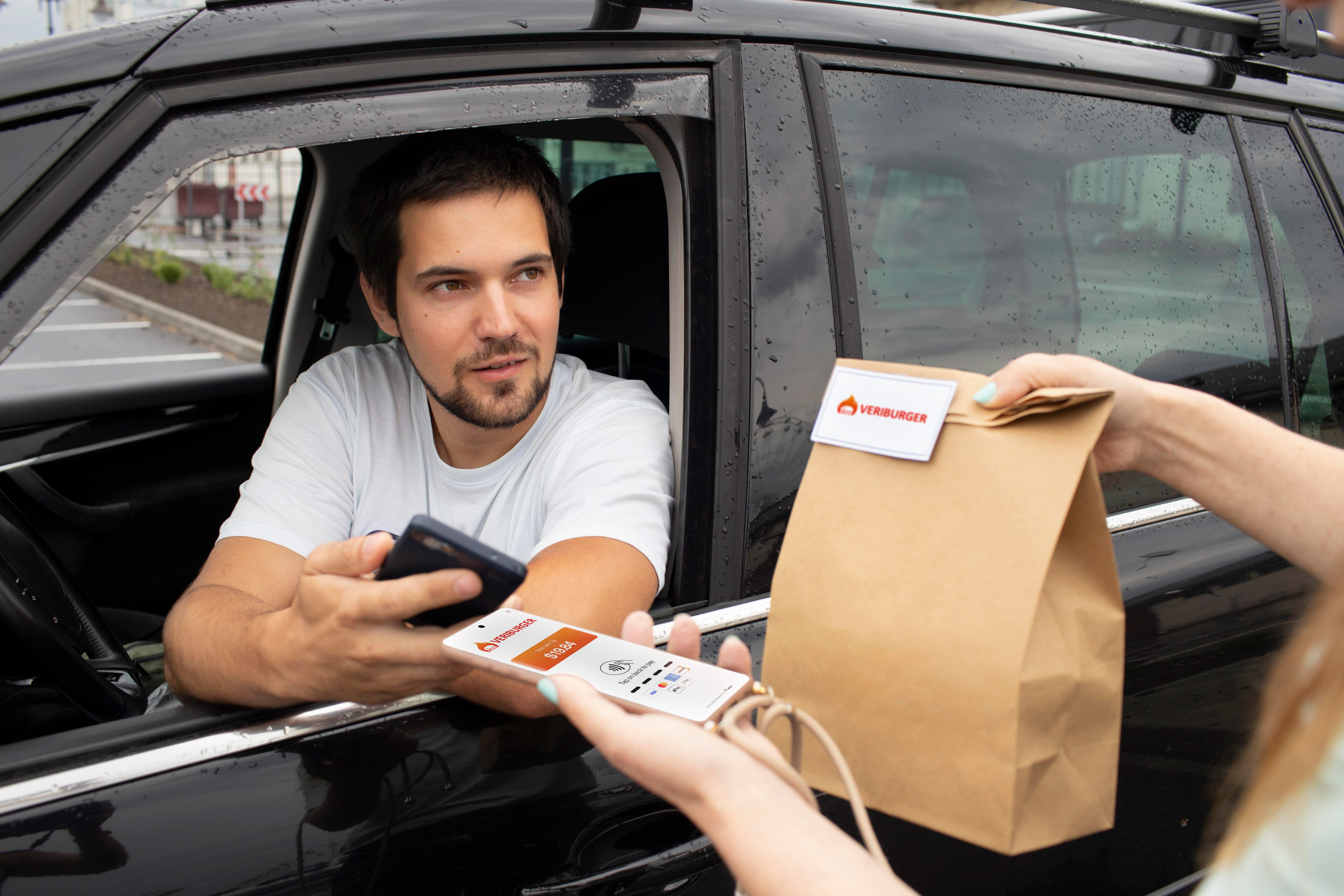
Contactless payment methods like tap to pay credit cards, digital wallets, and wearable devices allow customers to quickly and securely check out at restaurants. Instead of swiping or inserting a card, guests can simply tap or hold their card or device near a payment terminal.
Contactless payments use Near Field Communication (NFC) technology to encrypt transactions and securely transmit payment data, reducing the risk of credit card skimming and hacking. As Discover found, 86% of merchants agree that contactless payments help reduce wait times and 85% cite an increase in customer satisfaction.

Tokenization
Tokenization replaces sensitive payment data with a secure, non-reversible token, protecting guest information while enabling faster, frictionless transactions across every ordering channel.
In QSR environments, tokenization goes beyond security: it becomes the foundation for unified guest experiences. The same token that powers an in-store or drive-through transaction can also enable loyalty recognition, stored preferences, and seamless repeat ordering across mobile, kiosk, and digital channels without re-entering payment details or exposing card data.
End-to-end encryption (E2EE)
End-to-end encryption (E2EE) encrypts cardholder data at the point of card entry and keeps it encrypted until it reaches the payment processor. No intermediate system, including the restaurant's own POS, ever sees the raw data, dramatically reducing the restaurant’s compliance scope.
E2EE is different from encryption-in-transit, which only encrypts the data while it’s being transferred between the customer’s payment method and the restaurant’s POS or payment gateway. Meaning, other parties can still decrypt and access the data throughout the payment process, increasing risk.
EMV chip technology
EMV (Europay, Mastercard, and Visa) chip technology uses microprocessor chips instead of magnetic stripes to initiate and authenticate credit card payment transactions. The EMV chips generate a unique, encrypted code for each payment, reducing the risk of fraud and stolen data. This is now table stakes and a global standard for secure payments, not a unique differentiator.
The architecture problem: Why point solutions fail even when each one works
Even when restaurants support contactless payments, tokenization, and E2EE, they may still struggle to achieve both speed and security. That’s because they're using the right technologies assembled in the wrong architecture.
Stitching best-of-breed point solutions together may seem like the right solution, but it actually yields a glaring structural problem. Each additional middleware layer between the guest's payment and the merchant's settlement introduces:
- Processing latency
- A data handoff
- A new attack surface
Instead, restaurant operators must adopt a unified commerce infrastructure where payments, POS, loyalty, and reporting operate through a single integrated platform. As a result, data moves once, is encrypted once, is tokenized once, and settles directly. Fewer seams in the payment process leads to faster throughput and less opportunities for attacks and breaches.
How to implement a faster, more secure checkout: A practical path for operators
This step-by-step guide outlines how to modernize from fragmented payment systems to a unified architecture that delivers faster, more secure checkout experiences and long-term competitive advantage.
- Audit your current payment architecture for seams. Assess your entire payment flow, including fragmented tools, and identify points of vulnerability where data may be exposed.
- Confirm EMV and contactless compliance on all terminals. Make sure each POS device supports secure and convenient payment methods while meeting regulatory standards.
- Verify that tokenization is active, not just available. Work with your payment processor to enable tokenization and protect customer data when it's stored and shared between platforms.
- Enable end-to-end encryption from terminal to processor. Reduce your liability risk and compliance scope with E2EE, covering each step of the payment process.
- Integrate loyalty and guest recognition into the payment layer, not on top of it. Personalize checkout by meeting each customer with real-time loyalty offers, securely stored payment methods, and customized experiences.
- Establish chargeback monitoring cadences. Set up real-time alerts and review processes to track, flag, and manage chargeback disputes. According to Mastercard, many merchants use third-party solutions to reduce chargebacks, and 76% who use them find them effective.
Potential issues and strategies to address them
Reworking your restaurant payment system comes with its own obstacles, especially if you’re accustomed to using legacy platforms and fragmented tools.
Be aware of potential roadblocks, such as:
- Staff resistance to new terminals: Front-of-house staff may face a learning curve when adopting modern POS systems and devices. Provide proper training for seamless implementation and easy use.
- Internet connectivity dependence: Unified systems require strong and reliable internet connection across devices. Make sure your payment technology provider offers 24/7 support for quick fixes and minimal downtime.
- Integration complexity during migration: It may be difficult to connect new tools with legacy systems and other software like online ordering apps and loyalty platforms. Ensure data and workflows are properly synced by testing and slowly rolling out integrations for a smooth launch.
- Guest skepticism about contactless security: Customers may be reluctant to make tap-to-pay transactions and use digital wallets due to security concerns. At checkout, provide clear messaging about how payment information will be encrypted, protected, and, if applicable, securely stored.
The operators who win on both metrics are playing a different game
The speed-security trade-off at restaurant checkout is not an unavoidable constraint. It's an artifact of fragmented infrastructure that unified commerce platforms resolve structurally. Operators who modernize report faster table turns, lower fraud exposure, reduced PCI compliance costs, and stronger guest retention through integrated loyalty — all as outcomes of the same infrastructure decision.
The first step is understanding your current architecture well enough to know where the friction is. Only then can you properly update your restaurant payment system to reduce vulnerabilities, improve customer satisfaction, and increase revenue.
Curious how leading operators are strengthening security, simplifying operations, and building more scalable commerce experiences with Verifone? Check out this on-demand webinar.
Key Takeaways
- Many restaurants struggle to balance both speed and security at checkout because they’re using the right technologies assembled in the wrong architecture.
- Restaurants should incorporate modern payment solutions like NFC-enabled contactless payments, tokenization, end-to-end encryption, and EMV chip technology to improve the checkout process.
- Fragmented payment systems of mismatched best-in-breed solutions are rife with vulnerabilities for intercepted payments and stolen data.
- Restaurant operators must adopt a unified commerce infrastructure where payments, POS, loyalty, and reporting operate through a single integrated platform.
- Operators who modernize their infrastructure report faster table turns, lower fraud exposure, reduced PCI compliance costs, and stronger guest retention.
Frequently asked questions
1. Does contactless payment slow down service or speed it up?
Contactless payments such as tap to pay credit cards and wearable devices speed up service by enabling faster and more secure transactions. Instead of swiping a credit card, guests can tap or hold their card or device near a payment terminal.
2. What is tokenization and why does it matter for restaurant security?
Tokenization is the process of replacing customer data with a unique token — an alphanumeric code — that’s unreadable to hackers. For restaurants, tokenization enables more secure transactions and customer data usage across channels, such as loyalty rewards platforms and online ordering systems.
3. How does a unified payment platform differ from integrating multiple best-of-breed tools?
A unified payment platform ensures that data is encrypted, tokenized, and transferred once, reducing risks of data breaches and attacks. Integrating multiple best-of-breed tools, on the other hand, creates a structural problem where vulnerabilities arise in the payments process. Ultimately, building a unified restaurant payment platform allows for both speed and security at checkout.
4. What is the biggest payment security risk for restaurants in 2026?
The biggest payment security risks for restaurants in 2026 include POS system attacks like malware and card skimming, account takeover fraud via phishing and data breaches, and chargebacks and friendly fraud. Restaurants must develop unified payment systems that incorporate modern encryption technologies to protect customer data and reduce the risk of attacks.
About Verifone