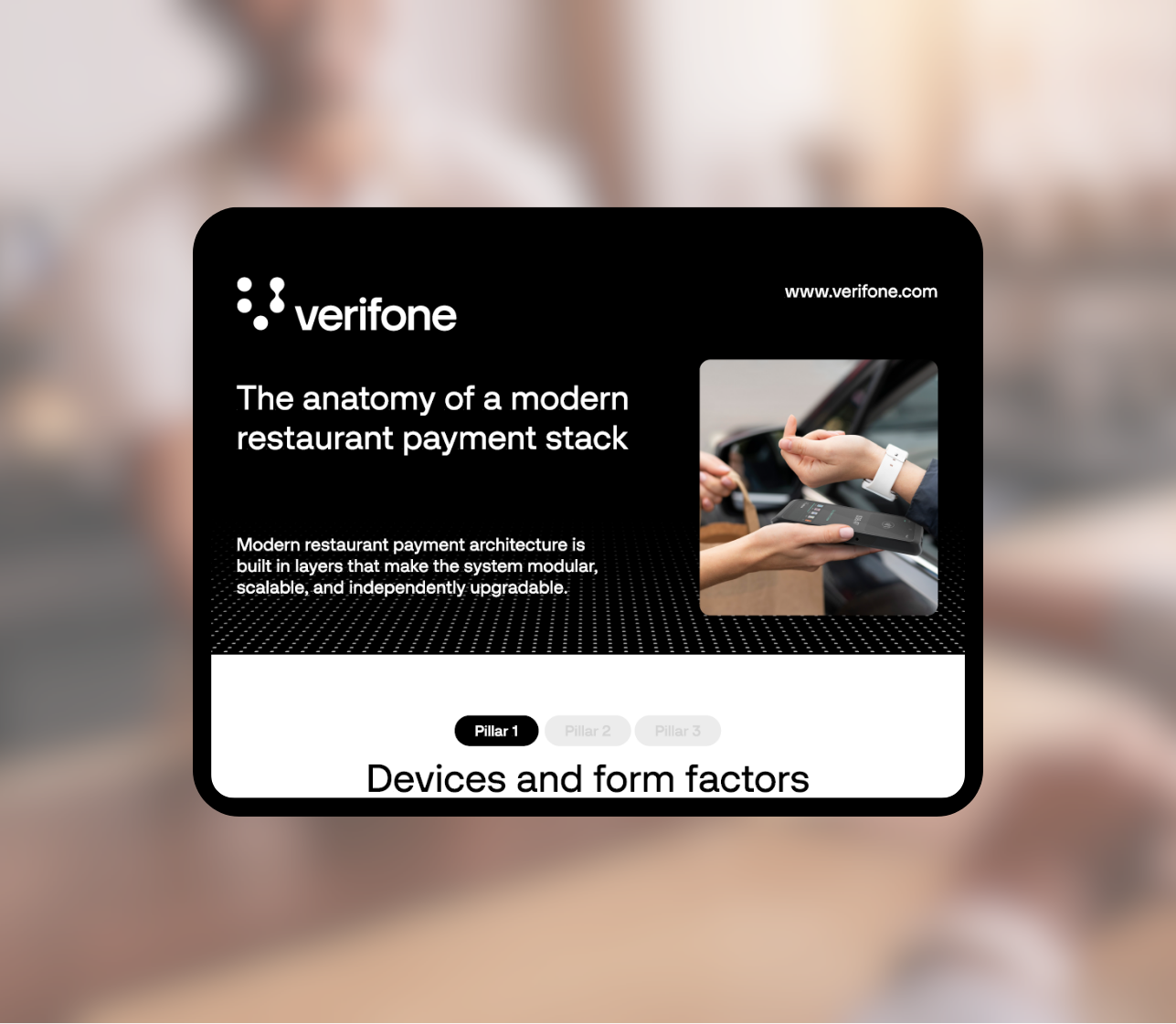
The anatomy of a modern restaurant payment stack

Executive Summary
For restaurant operators, payment fragmentation shows up in the moments you can least afford it: the lunch rush, the Friday dinner wave, the drive-thru line that stops moving. This infographic breaks down the three-pillar architecture of a modern restaurant payment stack
Restaurant operators know what payment failure looks like in practice. A drive-thru line that stops moving during peak hours. A loyalty redemption that doesn't go through at the kiosk. A server stuck rebooting a device while another table waits to check out. These aren't just frustrating moments — they're the visible symptoms of a payment architecture that wasn't built for the way restaurants operate today.
Nowadays, restaurant operations span more service models than ever: dine-in, drive-thru, curbside, self-service kiosks, mobile ordering, and third-party delivery. Each channel that gets added to a fragmented stack introduces new complexity.
Modern restaurant payment architecture is built in layers that are modular, scalable, and independently upgradable — so operators can evolve without ripping out what's already working.
See how the anatomy comes together. Explore our new infographic for the complete picture of what a modern restaurant payment stack looks like.
INFOGRAPHIC
A unified restaurant payment stack drives faster service, stronger loyalty, and more efficient operations
About Verifone