
The modern enterprise payment stack: Building flexibility, security, and scale
Your payment stack is either a competitive advantage or a ceiling. Most enterprises don't realize which one they have, until they try to build on it.
Get the resource
U.S. businesses lose $1.2 billion in sales per minute during the 8–13 minute window of a payment outage. By minute 23, that figure reaches $5.3B. (Payments Dive)
Fragmented payment infrastructure used to be a back-office inconvenience. Today it's a strategic constraint. Whether you're running stores, restaurants, or both, disconnected systems are quietly limiting checkout performance, slowing market expansion, and leaving your data in silos where it can't do its job.
The modern enterprise payment stack is different in its architecture. Every layer — devices, platforms, acquiring — is independently replaceable. That means you can modernize incrementally, without the costly rip-and-replace projects that keep IT teams up at night.
This eBook shows you what that looks like, and how to get there.
Built for leaders in enterprise setting
Whether you're managing fixed lane checkouts across specialty apparel stores or drive-thru and kiosk environments at QSR locations, the underlying problem is the same: disconnected systems that were never designed to scale together.
In retail, your customers move between digital and physical seamlessly. Your payment infrastructure should too. Discover how enterprise retailers are replacing aging, fragmented estates with open, modular architecture that supports associate mobility, loyalty integration, and biometrics, without forcing a full stack rebuild.
In restaurant technology. speed is your margin. Every second of checkout friction at counter, drive-thru, or kiosk is a second your guest is reconsidering. Explore the path from disconnected POS and payment systems to a unified infrastructure that supports every service model — dine-in, takeout, delivery, and digital ordering — at scale.
What modernization actually unlocks
Payment data becomes a strategic asset. Real-time payment data flows into fraud prevention, personalization, loyalty programs, and AI-driven commerce decisions — not just transaction processing.
Fragmentation gives way to orchestration. One integrated system replaces the patchwork. Adding AI, biometrics, or a new payment method becomes a competitive advantage, not a multi-vendor coordination project.
Global scale becomes achievable. Modular systems create infrastructure that's globally coherent yet flexible enough to meet local compliance, currency, and payment method requirements — market by market.
Open ecosystems accelerate innovation. Closed architectures once offered simplicity. Today their rigidity is a growth limiter. Open payment architecture moves with the business — no full rebuild required when a business decision demands change.
Discover More Resources and Get Inspired

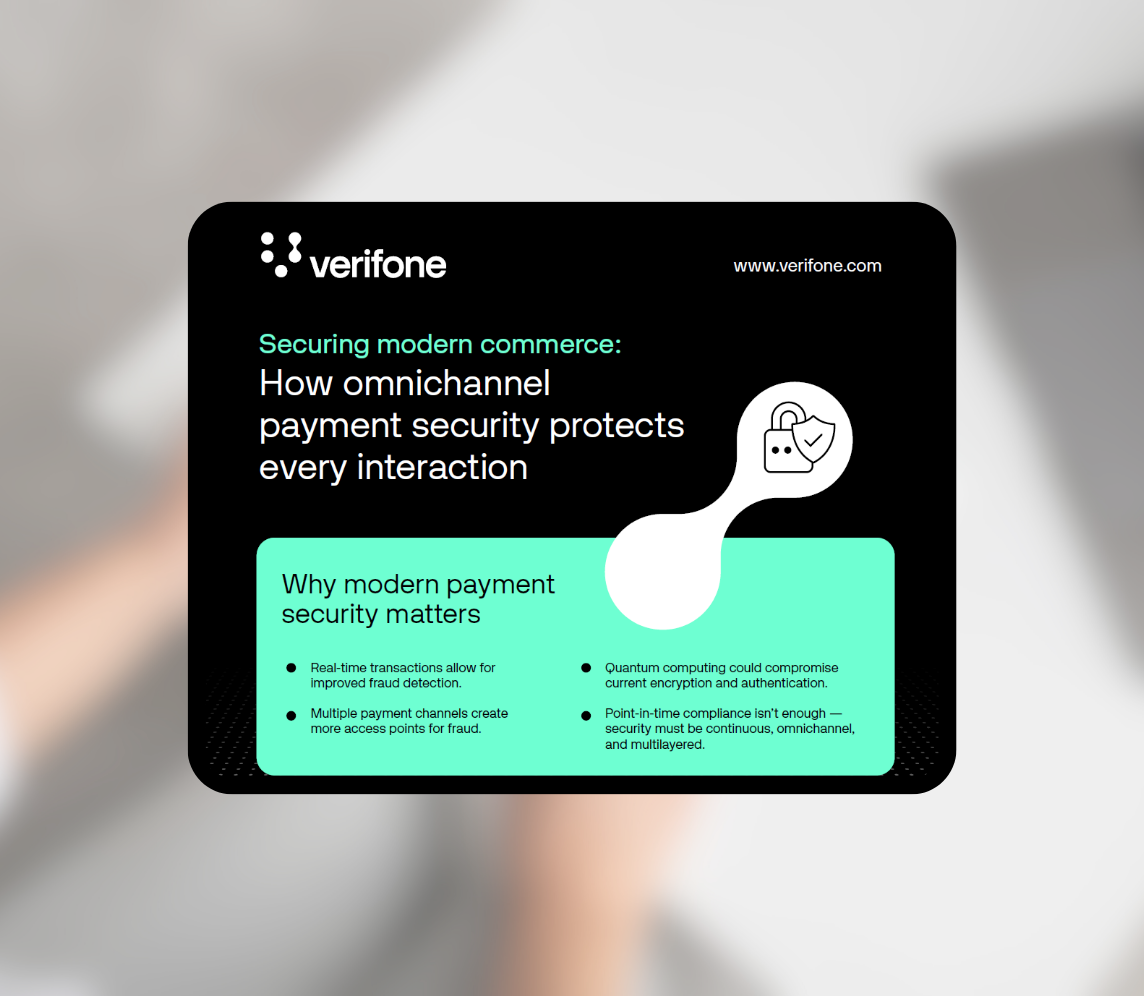
Securing modern commerce: How omnichannel payment security protects every interaction
About Us